



Explain how common size statements are p | Class 12 Accountancy - Company Accounts and Analysis of Financial Statements Chapter Analysis of Financial Statement, Analysis of Financial Statement NCERT Solutions

Q5.

Explain how common size statements are prepared giving an example.

Common size statements can be classified into two broad categories
(i) Common Size Income Statements
(ii) Common Size Balance Sheet
Common Size Statement is prepared in a columnar form for analysis. In a Common Size Statement, each item of the financial statements is compared to a common item. The analyses based on these statements are commonly known as Vertical Analysis. The following are the columns prepared in a Common Size Statement
(a) Particulars Column:This column shows the various financial items under their respective heads.
(b) Amount Columns :These columns depict the amount of each item, sub-totals and the gross total of a particular year.
(c) Percentage or Ratio Columns :These columns show the proportion of each item to the common item either in terms of percentage or ratio. The Common Size Statements can be presented in the following two ways. Method 1 Percentage column is shown beside the amount column of the year to which percentage column belongs.
NCERT Solutions for Class 12 Accountancy Part II Chapter 4 Analysis of Financial Statements LAQ Q5
Method 2 Amount columns are shown first and their percentage columns are shown after the amount columns.
NCERT Solutions for Class 12 Accountancy Part II Chapter 4 Analysis of Financial Statements LAQ Q5.1
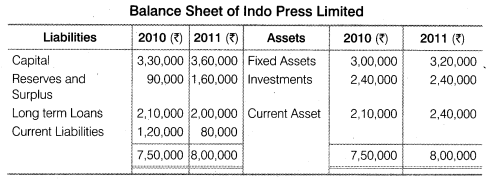
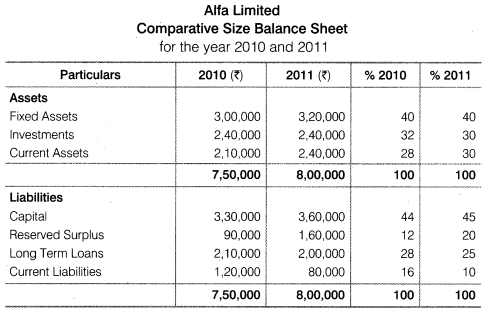
Example :From the following information provided by Alfa Limited Prepare the Common Size Statements.
NCERT Solutions for Class 12 Accountancy Part II Chapter 4 Analysis of Financial Statements LAQ Q5.2

NCERT Solutions for Class 12 Accountancy Part II Chapter 4 Analysis of Financial Statements LAQ Q5.3

👍 0
👎 0
✍️ Add Answer
🚩 Report

Study Tips for Answering NCERT Questions:

NCERT questions are designed to test your understanding of the concepts and theories discussed in the chapter. Here are some tips to help you answer NCERT questions effectively:

  • Read the question carefully and focus on the core concept being asked.
  • Reference examples and data from the chapter when answering questions about Analysis of Financial Statement.
  • Review previous year question papers to get an idea of how such questions may be framed in exams.
  • Practice answering questions within the time limit to improve your speed and accuracy.
  • Discuss your answers with your teachers or peers to get feedback and improve your understanding.

Important Questions & Answers

Why is this answer important for exams?

This question is important because it tests key concepts from the NCERT syllabus and is frequently asked in CBSE exams.

Which NCERT concept is used in this question?

This question is based on core NCERT concepts explained in the chapter and should be revised thoroughly before exams.

What is the correct answer to: Explain how common size statements are prepared giving an example.?

Common size statements can be classified into two broad categories
(i) Common Size Income Statements
(ii) Common Size Balance Sheet
Common Size Statement is prepared in a columnar form for analysis. In a Common Size S...

How do you solve Explain how common size statements are prepared giving an example. step by step?

Step-by-step explanation:
• Common size statements can be classified into two broad categories
• (i) Common Size Income Statements
• (ii) Common Size Balance Sheet
• Common Size Statement is prepared in a columnar form for analysis
• In a Common Size Statement, each item of the financial statements is compared to a common item

What common mistakes should be avoided in this question?

Students often lose marks by skipping steps, writing incomplete explanations, or misunderstanding keywords used in the question.

Latest Blog Posts

Stay updated with our latest educational content and study tips

Smart Questions to Ask in a Parent-Teacher Meeting | PTM Made Easy

Smart Questions to Ask in a Parent-Teacher Meeting | PTM Made Easy

Parent-Teacher Meetings (PTMs) are more than quick updates on marks — they’re a chance to build a real partnership between home and school. A good Parent-Teacher Meeting conversation helps parents see beyond grades. It opens up insights about a child’s strengths, struggles, emotions and even hidden talents. When parents participate actively, they don’t just track […]

Read More
The Secret to Smarter Learning — Building Strong Critical Thinking Skills

The Secret to Smarter Learning — Building Strong Critical Thinking Skills

In today’s world of endless information , knowing how to think is more important than knowing what to think . From school projects to real – life decisions , critical thinking helps students question ideas , analyze facts and form logical conclusions . But what exactly does critical thinking mean ? Simply put , it’s […]

Read More
Study Smarter, Not Harder: Build Productive Habits That Stick

Study Smarter, Not Harder: Build Productive Habits That Stick

Every student dreams of better grades , stronger focus and more study time – but the real challenge isn’t starting, it’s staying consistent . Building productive study habits is not about studying all day , it’s about studying smart . In today’s fast – paced digital world, distractions are everywhere – from endless phone notifications […]

Read More
The Hidden Risks of Online Gaming for Children — Is your child safe while gaming online?

The Hidden Risks of Online Gaming for Children — Is your child safe while gaming online?

Online gaming has rapidly become one of the most popular pastimes among children. Whether it’s multiplayer mobile games , PC adventures or console challenges , kids are spending more time than ever in the virtual world . On the surface, gaming seems entertaining and even educational – improving hand- eye coordination , teamwork and problem […]

Read More

Student Discussion

Be the first to comment.

ADD NEW COMMENT

        Can’t find your school? Type full name and submit.