
Discuss the general characteristics of G | Class 12 Chemistry Chapter The p-Block Elements, The p-Block Elements NCERT Solutions

Q1.

Discuss the general characteristics of Group 15 elements with reference to their electronic configuration, oxidation state, atomic size, ionisation enthalpy and electronegativity.

General trends in group 15 elements

(i) Electronic configuration: All the elements in group 15 have 5 valence electrons. Their general electronic configuration is ns2 np3.

(ii) Oxidation states: All these elements have 5 valence electrons and require three more electrons to complete their octets. However, gaining electrons is very difficult as the nucleus will have to attract three more electrons. This can take place only with nitrogen as it is the smallest in size and the distance between the nucleus and the valence shell is relatively small. The remaining elements of this group show a formal oxidation state of -3 in their covalent compounds. In addition to the -3 state, N and P also show -1 and -2 oxidation states.

All the elements present in this group show +3 and +5 oxidation states. However, the stability of +5 oxidation state decreases down a group, whereas the stability of +3 oxidation state increases. This happens because of the inert pair effect.


(iii) Ionization energy and electronegativity:

First ionization decreases on moving down a group. This is because of increasing atomic sizes. As we move down a group, electronegativity decreases, owing to an increase in size.


(iv) Atomic size: On moving down a group, the atomic size increases. This increase in the atomic size is attributed to an increase in the number of shells.

👍 0
👎 0
✍️ Add Answer
🚩 Report

Study Tips for Answering NCERT Questions:

NCERT questions are designed to test your understanding of the concepts and theories discussed in the chapter. Here are some tips to help you answer NCERT questions effectively:

  • Read the question carefully and focus on the core concept being asked.
  • Reference examples and data from the chapter when answering questions about The p-Block Elements.
  • Review previous year question papers to get an idea of how such questions may be framed in exams.
  • Practice answering questions within the time limit to improve your speed and accuracy.
  • Discuss your answers with your teachers or peers to get feedback and improve your understanding.

Important Questions & Answers

Why is this answer important for exams?

This question is important because it tests key concepts from the NCERT syllabus and is frequently asked in CBSE exams.

Which NCERT concept is used in this question?

This question is based on core NCERT concepts explained in the chapter and should be revised thoroughly before exams.

What common mistakes should be avoided in this question?

Students often lose marks by skipping steps, writing incomplete explanations, or misunderstanding keywords used in the question.

What is the correct answer to: Discuss the general characteristics of Group 15 elements with reference to their electronic configuration, oxidation state, atomic size, ionisation enthalpy and electronegativity.?

General trends in group 15 elements

(i) Electronic configuration: All the elements in group 15 have 5 valence electrons. Their general electronic configuration is ns2 np3.

(ii) Oxidation states: All these elements ...

How do you solve Discuss the general characteristics of Group 15 elements with reference to their electronic configuration, oxidation state, atomic size, ionisation enthalpy and electronegativity. step by step?

Step-by-step explanation:
• General trends in group 15 elements

• (i) Electronic configuration: All the elements in group 15 have 5 valence electrons
• Their general electronic configuration is ns2 np3

Latest Blog Posts

Stay updated with our latest educational content and study tips

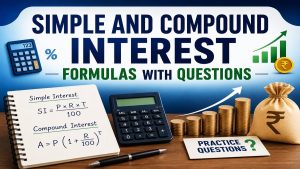
Simple and Compound Interest Formulas with Questions

Simple and Compound Interest Formulas with Questions

Interest is one of the most significant ideas in maths and financial calculations. It is very common in banking, loan applications, investments, saving account and competitive exams. Simple Interest and Compound Interest make it easier to find out how much more is earned and/or paid on a principal during the period of time. These Interest … Read more

Read More
Spoken English Course Topics for Beginners in 2026

Spoken English Course Topics for Beginners in 2026

In 2026, students, professionals, and job seekers must have a high level of spoken English. Spoken English is a beginner level course to enhance learners’ communication skills in English, their pronunciation, vocabulary, grammar structure and confidence in speaking English fluently. Today, the emphasis of spoken English courses is placed on actual conversations, everyday speech practice … Read more

Read More
Difference Between AI and Machine Learning

Difference Between AI and Machine Learning

Artificial Intelligence (AI) and Machine Learning (ML) are two of the most sought-after technologies in today’s digital era. Although these terms are often used together, they are not the same. Machine Learning is, in fact, a component of Artificial Intelligence that enables systems to learn and enhance on their own, without direct programming. AI is … Read more

Read More
Time, Speed and Distance Formulas

Time, Speed and Distance Formulas

Time, Speed, and Distance are some of the most important concepts in mathematics and aptitude. These are the concepts which are used to calculate the speed of an object, time taken for an object to move and the distance traveled during the motion. Questions from this topic are frequently seen in School Tests, Competitive Tests, … Read more

Read More

Student Discussion

Hitesh
Class · · , · Jul 06, 2019
Thanks
👍 👎 Reply
Shreya sinha
Class · · , · Mar 07, 2019
Thnx
👍 👎 Reply

ADD NEW COMMENT

        Can’t find your school? Type full name and submit.